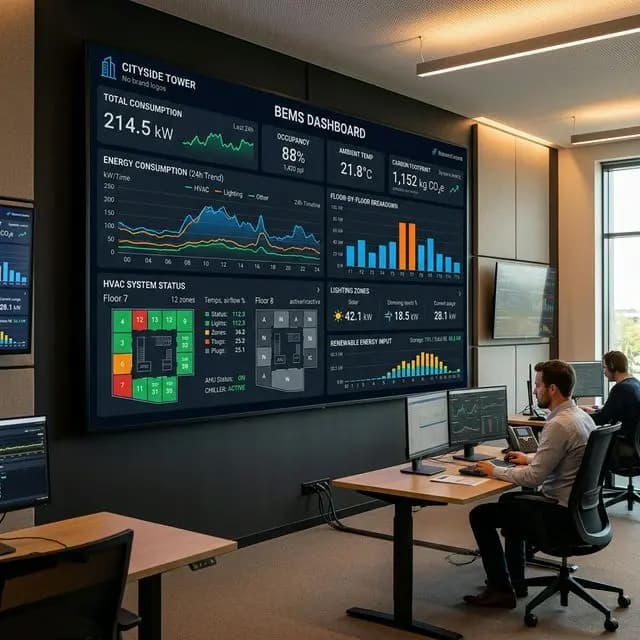
Industrial AI Market Update (2026-W15): Grid Access, Electrical Supply, and OT Connectivity Became One Buying Decision
Week 15 market update for OEMs, utilities, and industrial operators: why industrial AI programs now pass or fail on grid access, electrical infrastructure supply, and OT connectivity readiness.
One-line decision for buyers: In the 30 days ending April 6, 2026, industrial AI became a three-gate procurement problem: if you cannot prove a grid path, electrical delivery path, and OT connectivity path together, the program is unlikely to pass budget review.
Research window and method
This page covers March 8, 2026 to April 6, 2026 for United States + global industrial markets.
We ran three research angles and only kept events that changed deployment or buying behavior:
- Policy / standards / public infrastructure: DOE, NIST, IEA.
- Industrial deployment packaging: Siemens, Hitachi Energy, Rockwell official releases.
- Integration feasibility signals: electrical capacity, interconnection, OT connectivity, and serviceability.
Inclusion rule: an item must change at least one of product scoping, integration sequencing, utility coordination, risk controls, or commercial model assumptions.
What Changed (Last 30 Days)
| Date | Primary source | What changed | Why it matters now |
|---|---|---|---|
| 2026-03-12 | U.S. DOE Office of Electricity | DOE announced an approximately $1.9B SPARK grid-upgrade funding opportunity. | AI-heavy projects now face earlier screening on transmission and capacity timing, not only software scope. |
| 2026-03-12 | U.S. DOE Office of Electricity | SPARK timeline specified: concept papers due 2026-04-02, full applications due 2026-05-20. | This turns “grid modernization” into a procurement calendar with immediate planning consequences. |
| 2026-03-18 | Siemens Smart Infrastructure | Siemens announced a data-center ecosystem expansion (Emerald AI, Fluence, PhysicsX) to combine compute flexibility and grid integration. | Buyers now expect suppliers to manage both IT workload behavior and physical power constraints. |
| 2026-03-20 | U.S. DOE + DOC + SoftBank + AEP Ohio | Partnership announced around 10 GW generation + 10 GW data-center development; $4.2B transmission investment. | Large AI infrastructure is being packaged as a full energy-and-transmission program, not a standalone digital project. |
| 2026-03-20 | Siemens | Siemens announced $165M U.S. manufacturing expansion for AI-related electrical infrastructure and more than 350 jobs. | Electrical delivery lead-time and supplier capacity are now explicit gating factors in AI deployment plans. |
| 2026-03-23 | NIST | NIST Cyber AI Profile workshop reflections emphasized OT use cases, testing/evaluation, taxonomy, transparency/AIBOM, and HITL. | Governance requirements are moving from abstract “trust” language into practical implementation artifacts. |
| 2026-03-23 | Hitachi Energy | Hitachi launched HMAX Energy with plan/predict/prevent service model and published performance reference cases. | Infrastructure vendors are monetizing AI through lifecycle reliability and service attach, not only hardware. |
| 2026-03-26 | U.S. DOE Office of Nuclear Energy | DOE announced AI-assisted licensing workflow: a 208-page draft in one day vs a typical 4–6 weeks conversion process. | Utilities and regulated operators now have evidence that AI can compress document-heavy deployment cycles when human validation stays in loop. |
| 2026-03-26 | Rockwell Automation | Rockwell framed Hannover Messe around industrial-grade AI, digital twins, and secure-by-design OT architectures. | “Autonomy” claims are being tied to OT security and commissioning realism, not only model demos. |
| 2026-03-27 | IEA | IEA published Energy and AI in East Asia on data-center demand growth and grid planning implications. | Global grid-planning pressure is broadening; U.S. buyers should not assume this is a local anomaly. |
| 2026-04-01 | Siemens | Siemens expanded private 5G infrastructure to the U.S. and additional countries, with CBRS support and edge runtime on routers. | For OEMs and operators, OT-grade connectivity is becoming part of AI readiness criteria, not an afterthought. |
Why It Matters Now
The short version: market friction moved from model selection to execution coupling.
In practical terms, week 15 showed a tighter coupling between three layers:
- Power and grid path: interconnection, transmission, load behavior.
- Electrical delivery capacity: switchgear, distribution systems, protection, installability.
- OT connectivity and control safety: deterministic networks, protocol support, fallback and governance.
If one layer is weak, deployment velocity drops even when AI capability is strong.
Decision Matrix for Buyers
| Decision domain | Latest signal | Buyer-side implication | Near-term action |
|---|---|---|---|
| Grid access and timing | DOE SPARK timeline + Ohio partnership structure | Capacity path needs to be locked before AI feature scope is finalized | Add interconnection and flexibility assumptions to phase-zero |
| Electrical supply and installability | Siemens U.S. manufacturing expansion for AI infrastructure | Lead times and prefabrication options now affect go-live confidence | Prequalify electrical suppliers earlier in the program |
| OT connectivity backbone | Siemens U.S. private 5G expansion with CBRS and edge runtime | Deterministic, secure wireless can unlock AI at moving or hard-wired-constrained assets | Define where private 5G is required vs optional |
| Regulated workflow acceleration | DOE NE AI-assisted licensing demonstration | AI can compress documentation-heavy workflows with expert validation | Pilot one bounded workflow with human approval gates |
| Lifecycle service monetization | Hitachi HMAX Energy service model | Value shifts toward uptime, maintenance, and failure prevention | Rebuild pricing around recurring reliability outcomes |
| Factory autonomy positioning | Rockwell autonomy + secure OT narrative | Buyers expect architecture proof, not autonomy marketing only | Require commissioning/fallback evidence in vendor scoring |
| Governance and accountability | NIST Cyber AI Profile workshop findings | Governance deliverables become procurement artifacts | Request test plans, traceability, and override policy up front |
| Regional context and planning | IEA East Asia report on AI-energy interactions | Power constraints are global and persistent, not one-market noise | Stress-test expansion plans across multiple grid contexts |
Who Should Act Now
| Audience | Why this week matters | What to do in the next 30 days |
|---|---|---|
| OEM product teams | Buyers now ask for deployability and retrofitability, not only AI features | Publish one deployment-ready reference architecture with power + connectivity prerequisites |
| Utilities and grid-facing teams | Large-load programs are being negotiated with flexibility and transmission economics at the center | Require load-shape and curtailment disclosure earlier in intake |
| Electrical equipment vendors | AI revenue is moving to lifecycle intelligence and service performance | Package maintenance and reliability KPIs as primary offer components |
| System integrators | Integration complexity is widening across IT/OT/power domains | Add electrical and OT network audit tasks to discovery SOW by default |
| Industrial operators | Budget approvals now fail on hidden infrastructure assumptions | Run a readiness review: power, controls, connectivity, and governance in one workshop |
Integration / Deployment / Commercial Impact
Product and integration
- Architecture-first selling is replacing feature-first selling. A good model demo no longer offsets unclear electrical or OT assumptions.
- Connectivity is now economic infrastructure. The April 1 private 5G expansion signal matters because it addresses shop-floor data transport, edge execution, and operational control boundaries together.
- IT/OT convergence has become a utility question. Siemens’ March 18 ecosystem framing and DOE’s March 20 partnership both imply that compute scheduling and power behavior are converging in approval workflows.
Commercial and procurement
- Recurring value beats pilot value. Hitachi’s plan/predict/prevent packaging reflects where budget owners are moving: reduced outage cost, reduced inspection burden, and more predictable asset life.
- Capex timing now depends on infrastructure queueing. DOE SPARK deadlines and announced infrastructure financing create concrete windows that procurement teams can no longer treat as background context.
- Regulated environments can gain speed if governance is explicit. DOE NE’s March 26 case shows acceleration is possible when AI supports experts, rather than bypassing expert accountability.
Action Checklist (30 / 60 / 90 Days)
| Time horizon | OEMs & equipment vendors | Utilities & integrators | Operators & facility owners |
|---|---|---|---|
| Next 30 days | Separate “AI feature roadmap” from “deployment readiness roadmap” | Add grid-path, load-flex, and OT-boundary questions to every intake form | Identify top 10 assumptions that can block rollout after purchase |
| Next 60 days | Pilot one installed-base service package with measurable reliability KPI | Build one reusable checklist for interconnection + cyber + control fallback | Execute one cross-functional design review (OT, IT, facilities, finance) |
| Next 90 days | Convert one product line to a lifecycle offer with SLA-backed metrics | Run one customer program with phased autonomy gates (advisory → assistive) | Move one AI use case from pilot to governed production with audit trail |
Risks, Limits, and Evidence Gaps
| Risk or boundary | What can be misread | How to mitigate |
|---|---|---|
| Over-reading public announcements | Funding announcements do not equal immediate site capacity | Track project-level timelines, not headlines |
| Vendor reference-case inflation | Performance percentages may not transfer across asset mixes | Recalculate with your downtime, staffing, and maintenance baseline |
| Governance under-specification | “Responsible AI” language without implementation artifacts | Require testing protocol, HITL design, and provenance evidence |
| Connectivity overconfidence | Private 5G is not a universal replacement for all wired architecture | Define deterministic latency and safety requirements per use case |
| Regional generalization | Global signals do not guarantee identical U.S. grid constraints by region | Use location-specific interconnection and tariff assumptions |
| Evidence gap on regulation finalization | No single new final industrial AI regulation dominated this window | Treat this period as operational convergence, not legal reset |
FAQ
What changed most for procurement teams this week?
Procurement moved from comparing AI tools to validating deployment preconditions. Teams now need a synchronized answer on grid path, electrical delivery, and OT-ready connectivity before approving spend.
Is this only relevant to hyperscale facilities?
No. OEM retrofit programs, utility-interfacing projects, and building-system modernization now encounter the same coupling of power constraints, integration complexity, and governance requirements.
Why include a nuclear licensing example in an industrial AI page?
Because it is a documented example of AI compressing a regulated, document-heavy workflow while retaining expert review. That pattern is transferable to other high-assurance industrial contexts.
Should buyers standardize on one vendor after these announcements?
Not by default. The practical move is to standardize decision criteria and interoperability requirements, then evaluate vendors against that baseline.
Do these signals mean autonomy is production-ready everywhere?
No. The stronger conclusion is that autonomy conversations are becoming more operationally grounded, with OT architecture and security evidence required earlier.
What is the most common mistake in buyer evaluations now?
Treating connectivity, power, and governance as separate workstreams. In this cycle, those dependencies are tightly linked and should be evaluated together.
How should system integrators adapt commercial scope?
Price and staff phase-zero for power path, OT connectivity, and fallback design explicitly. Hiding this work as “implementation overhead” is now a delivery risk.
What should be in the first buyer workshop agenda?
Load profile assumptions, interconnection constraints, electrical lead-time risk, OT network topology, control boundaries, and governance artifacts required for go-live.
Internal next reads
- April 2026 industrial AI market update
- March 2026 industrial AI market update
- Industrial AI integration services
- AI retrofit programs
- OEM AI product development
- AI energy management systems
If you need to turn this week’s signal into an execution plan, start with one product family or one site program and run a joint review across power, OT connectivity, and governance evidence. For implementation support, use industrial AI integration services or contact us.
Sources
- Energy Department Announces $1.9B Investment in Critical Grid Infrastructure to Reduce Electricity Costs — U.S. Department of Energy Office of Electricity — March 12, 2026.
- Energy Department Announces Partnership to Ensure Affordable Energy and Power America’s AI Future — U.S. Department of Energy — March 20, 2026.
- Department of Energy Unleashes AI to Reduce Reactor Licensing Timelines — U.S. Department of Energy Office of Nuclear Energy — March 26, 2026.
- Reflections from the Second NIST Cyber AI Profile Workshop — National Institute of Standards and Technology — March 23, 2026.
- Energy and AI in East Asia — International Energy Agency — Published March 27, 2026.
- Siemens expands data center partner ecosystem to scale next-generation AI infrastructure — Siemens Smart Infrastructure — Press Release, March 18, 2026.
- Siemens invests $165 million to expand U.S. manufacturing for AI infrastructure — Siemens AG — Press Release, March 20, 2026.
- Siemens expands its private 5G infrastructure to the United States and seven additional countries — Siemens AG — Press Release, April 1, 2026.
- Hitachi launches HMAX Energy, a pioneering AI-powered service and solution suite for critical energy infrastructure — Hitachi Energy — Press Release, March 23, 2026.
- Rockwell Automation Showcases Autonomous Industrial Operations at Hannover Messe 2026 — Rockwell Automation — Press Release, March 26, 2026.
作者

Jimmy Su
分类
更多文章
Industrial AI Market Update (2026-W15): OT Cyber Readiness Became the Fourth Budget Gate
Decision-oriented industrial AI update for OEMs, utilities, electrical equipment vendors, and integrators. In the 30 days ending April 8, 2026, deployment approval shifted from a 3-gate model to a 4-gate model with OT cyber readiness now explicit.
April 2026 Industrial AI Market Update: Flexibility, Retrofitability, and Service-Led Infrastructure Enter the Buying Checklist
Industrial AI market update for April 2026: power flexibility, retrofit paths, OT governance, and service economics shaping OEM and utility buying decisions.

Industrial AI Market Update (2026-W16): Grid and OT Governance Reset the Buyer Approval Standard
Decision-oriented update for OEMs, utilities, electrical equipment vendors, and system integrators. In the 30 days ending April 18, 2026, interconnection reform, critical-infrastructure AI risk profiling, and OT threat activity converged into a stricter go-live standard.