
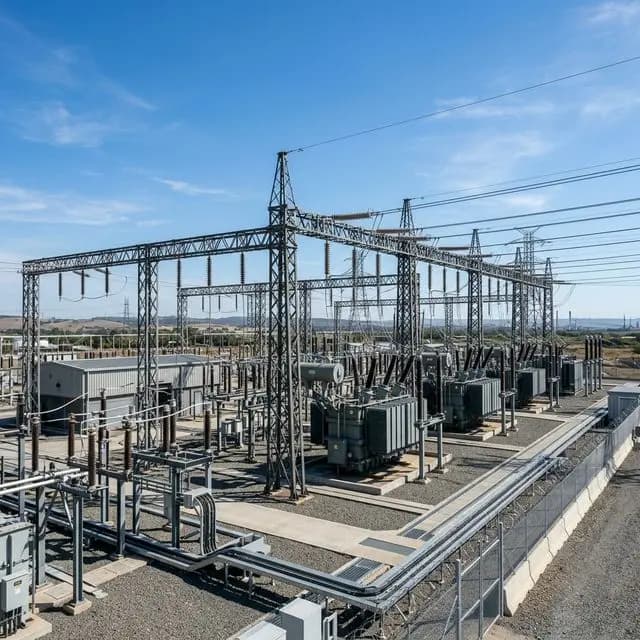
Industrial AI Market Update (2026-W17): Hannover Agentic Claims Met Grid and OT Evidence Deadlines
Decision-oriented update for OEM product teams, utilities, electrical equipment vendors, and integrators. In the 30 days ending April 20, 2026, procurement shifted from demo velocity to auditable deployment evidence.
One-Line Decision: For industrial AI contracts signed before June 2026, approve scale only when the supplier submits one auditable package for large-load pathway, OT cyber controls, engineering-change rollback, and commercial accountability.
Research Window and Method
This update covers March 21, 2026 to April 20, 2026 for United States + global industrial markets.
We used three research angles and retained only signals that can change product, integration, procurement, or operations decisions:
- Regulation and standards: NIST, NERC, FERC, DOE, Federal Register checks.
- Industrial supplier delivery signals: Schneider Electric, Siemens, and Hitachi Energy.
- Utility and system-level coordination: EPRI, IEA, and critical-infrastructure cyber advisories.
Inclusion rule: each item must materially alter at least one of these buyer levers:
- approval sequence,
- required evidence artifacts,
- integration architecture requirements,
- commercial terms or risk allocation.
What Changed (Last 30 Days)
| Date | Primary source | What changed | Why buyer committees care now |
|---|---|---|---|
| 2026-04-01 | NERC | Computational-load registration criteria and Project 2026-02 comment period opened. | Large AI-related loads are entering explicit reliability governance pathways, affecting intake assumptions and approval sequence. |
| 2026-04-02 | Hitachi Energy | Announced a new USD 10M NC power electronics center and 150 jobs. | Buyers can score local delivery and support capacity, not only product specs. |
| 2026-04-07 | NIST | Released concept note for an AI RMF profile focused on critical infrastructure deployment. | CI-focused AI risk artifacts are becoming a practical procurement expectation. |
| 2026-04-07 | CISA + FBI + NSA + DOE + EPA + CNMF | Advisory AA26-097A warned of PLC exploitation activity across US critical infrastructure. | OT cyber controls moved from post-pilot hardening to pre-scale gating. |
| 2026-04-14 | EPRI + Open Compute Project | Announced collaboration to treat data centers as flexible grid resources. | Utilities and operators now have a stronger basis to request flexibility behavior and grid-service posture in contracts. |
| 2026-04-14 | Hitachi Energy + Samsung C&T | Expanded strategic collaboration on resilient AC grid infrastructure delivery. | Grid-facing projects should increase delivery-chain scrutiny and EPC execution checks in RFQs. |
| 2026-04-16 | FERC (RM26-4) | Announced action target by June 2026 for large-load interconnection proceeding. | Teams must budget for process and cost-allocation uncertainty in near-term programs. |
| 2026-04-16 | U.S. DOE | Publicly supported accelerated large-load interconnection reform. | Federal signaling reinforces urgency for load-plus-generation planning in bid strategy. |
| 2026-04-16 | Schneider Electric | Agentic manufacturing release with industrial copilot claims and engineering-cycle compression metrics. | Buyer teams should shift from feature demos to acceptance-test criteria tied to real change-control outcomes. |
| 2026-04-16 | Siemens + KION | Announced AI, automation, and simulation partnership for supply-chain operations. | Integration evaluation should include digital twin readiness, operational data ownership, and rollout governance. |
| 2026-04-16 | IEA | Published and launched new analysis package on Energy and AI. | Energy assumptions for industrial AI business cases need faster refresh and scenario sensitivity checks. |
Why It Matters Now
This month changed buyer logic from "Can this model do it?" to "Can this be deployed, governed, and defended?".
The decisive shift is cross-domain coupling:
- Load and interconnection coupling: power-path assumptions can block otherwise strong AI programs.
- Security and operations coupling: active OT threat pressure forces segmentation and response readiness earlier.
- Vendor claim and contract coupling: Hannover-era agentic claims now need acceptance clauses and rollback terms.
- Global energy context coupling: demand baselines are moving fast enough to invalidate stale ROI models.
Who Should Act Now
| Role | What changed for this role | Immediate decision upgrade |
|---|---|---|
| OEM product teams | Buyers ask for deployability evidence, not just capability narratives. | Add a standard "deployment evidence annex" to every proposal and product brief. |
| Utilities and grid-facing operators | Computational-load and interconnection treatment is becoming more formal. | Require load flexibility assumptions and fallback operation envelopes at intake. |
| Electrical equipment vendors | Channel pressure moved toward serviceability, patchability, and cyber-operational assurance. | Bundle lifecycle service terms and OT hardening responsibilities in quotes. |
| System integrators | Discovery now must include power-path, OT-path, and governance-path from day zero. | Re-scope phase-zero to include interconnection and incident-playbook readiness. |
| Industrial operators | Pilot success no longer secures scale approval alone. | Run one contract-readiness drill with engineering, OT, cyber, and procurement. |
| Distributors/channel partners | Commodity comparison is losing to risk-adjusted deployment confidence. | Sell qualified solution bundles, not AI feature lists. |
Integration and Deployment Impact
| Evidence package | Minimum proof required | Common failure mode seen in active deals | Buyer-side fix |
|---|---|---|---|
| Interconnection package | Queue pathway, MW profile, curtailment behavior assumptions | AI scope approved before load behavior is contractable | Add a signed load-behavior appendix before PO release |
| OT cyber package | Segmentation diagram, exposed-asset controls, patch ownership | Security controls deferred to post-commissioning | Set cyber controls as pre-go-live acceptance criteria |
| Engineering package | Change-control workflow, rollback trigger, sign-off authorities | Vendor claims speed-up but no failure boundary definition | Require rollback test in FAT/SAT protocol |
| Operations package | Operator override design, alert pathways, training coverage | Automation authority unclear during abnormal states | Map human authority and escalation path in SOP |
| Commercial package | SLA, warranty limits, incident response duty matrix | Responsibility gaps between OEM, SI, and operator | Contract a single RACI-based accountability matrix |
Commercial Impact: Bid Evaluation Matrix
| Evaluation dimension | Legacy weighting (pilot era) | Recommended weighting (current) | Procurement question to add now |
|---|---|---|---|
| Model capability | High | Medium | What failure envelope is declared for this capability? |
| Integration readiness | Medium | High | Which interfaces are productized vs project-customized? |
| Interconnection realism | Low | High | What is the documented load profile and timeline risk? |
| OT cyber posture | Medium | High | Which controls are built-in vs customer responsibility? |
| Change governance | Low | High | How are rollback, approvals, and evidence retention handled? |
| Commercial accountability | Medium | High | Who pays for downtime when assumptions fail in production? |
Risks, Limits, and Evidence Gaps
| Risk or boundary | What we know | What remains uncertain | Practical mitigation |
|---|---|---|---|
| Vendor performance claims | Suppliers now publish stronger cycle-time and autonomy claims. | Public claims still vary in measurement method and baseline. | Convert claims into plant-specific acceptance tests and penalty clauses. |
| Interconnection policy timing | FERC indicated action by June 2026 on RM26-4. | Final scope and implementation effects are not yet final in this window. | Price timeline and cost-allocation contingencies into bids now. |
| Computational-load governance | NERC project and criteria work are active with open comments. | Final definitions and reliability obligations can still evolve. | Keep architecture and contracts modular to absorb criteria updates. |
| OT advisory pressure | AA26-097A confirms threat relevance for PLC environments. | Advisory does not imply identical exploitability in every site. | Perform site-specific exposure review and control validation. |
| Federal Register signal strength | We did not identify a new industrial-AI-specific final rule in this exact 30-day window. | Rulemaking pace and cross-agency alignment remain fluid. | Treat this as a process-shift period, not a finished compliance endpoint. |
Buyer Action Checklist (Next 30 Days)
Action Checklist
- Freeze one cross-functional approval template with the four evidence layers shown above.
- Require a quantified load-behavior annex in every proposal touching AI-enabled operations.
- Add an OT cyber pre-go-live checklist referencing exposed PLC and remote-access controls.
- Insert rollback and operator-authority tests into FAT/SAT, not only model KPI testing.
- Re-score all active bids with the updated weighting matrix before final award.
- Re-baseline ROI scenarios using updated energy and interconnection assumptions dated April 2026.
- Record explicit responsibility boundaries among OEM, integrator, and operator in contract schedules.
Who Should Act Now
- OEM product leaders: publish deployability evidence packs as a default commercial artifact.
- Utilities and operators: demand flexibility and control-boundary proof before approving scale.
- Integrators: reprice discovery around reliability, cyber, and change governance work.
- Distributors: package services and accountability, not just equipment and features.
FAQ
1) Is this update saying agentic industrial AI is not ready?
No. It says readiness is now decided by deployment evidence quality, not by demo quality alone.
2) Are NERC and FERC already forcing one final technical architecture?
No. Current signals are directionally strong, but implementation details are still moving.
3) Why include cybersecurity advisory content in an AI market update?
Because OT exploitation risk directly changes go-live approvals and insurance/commercial terms for AI-enabled operations.
4) How should we treat Siemens, Schneider, and other Hannover claims?
Treat them as candidate capabilities and verify with your own acceptance tests, data rights, and rollback requirements.
5) What changes first in procurement documents?
RFPs and SOWs should gain explicit sections for load behavior, OT controls, change governance, and accountability matrix.
6) Does this only apply to hyperscale data centers?
No. It also applies to OEM equipment programs, utility-facing assets, and building/industrial systems with AI-enabled control layers.
7) What if our pilot already succeeded?
Pilot success is useful evidence, but not sufficient for scale without operational and commercial control artifacts.
8) What is one board-level metric to add immediately?
Track the percentage of AI programs that have all four evidence layers signed before capital release.
Related Reads and Next Step
- Previous update: /blog/industrial-ai-market-update-week-16-2026-grid-and-ot-governance-reset
- Earlier context: /blog/industrial-ai-market-update-april-2026
- Implementation support path: /services/ai-consulting
If your team is evaluating live deals this quarter, run a single decision workshop with engineering, OT, security, and procurement using the checklist and matrix above before final award.
Sources (Primary, Verifiable)
Author

Jimmy Su
Industrial AI and automation market analyst
Categories
More Posts

Industrial AI Market Update (2026-W16): Grid and OT Governance Reset the Buyer Approval Standard
Decision-oriented update for OEMs, utilities, electrical equipment vendors, and system integrators. In the 30 days ending April 18, 2026, interconnection reform, critical-infrastructure AI risk profiling, and OT threat activity converged into a stricter go-live standard.
Industrial AI Market Update (2026-W18): Flexibility Readiness and OT Control Evidence Became the New Approval Clock
Decision-oriented update for OEM product teams, utilities, electrical equipment vendors, integrators, and operators. In the 30 days ending April 27, 2026, grid flexibility rules, computational-load governance, and OT cyber pressure tightened industrial AI deployment approvals.
Industrial AI Market Update (2026-W15): OT Cyber Readiness Became the Fourth Budget Gate
Decision-oriented industrial AI update for OEMs, utilities, electrical equipment vendors, and integrators. In the 30 days ending April 8, 2026, deployment approval shifted from a 3-gate model to a 4-gate model with OT cyber readiness now explicit.
Direct email
No newsletter signup
We are not running a newsletter. Use [email protected] for project questions, resource requests, and follow-up discussions.